PVC vs. HDPE Pipes for Irrigation
PVC vs. HDPE Pipes for Irrigation: Which Lasts Longer in Kenyan Soil?
Choosing between PVC and HDPE pipes for your irrigation system isn’t just a procurement decision—it’s a strategic investment in your farm’s lifeline. Kenya’s demanding agricultural environment presents unique challenges. The equatorial sun beats relentlessly, soils range from acidic volcanic loam to expansive black cotton, and water scarcity makes every drop precious.
Selecting the wrong pipe material can mean costly system failures, reduced yields, and expensive replacements within just a few years. The backbone of any successful irrigation system is its distribution network. That network must endure decades of pressure cycles, chemical exposure, soil movement, and UV bombardment.
At Namani Irrigation (https://namaniirrigation.co.ke), we’ve spent years installing and maintaining irrigation systems across Kenya’s diverse agricultural zones. We understand that durability starts with the right material choice matched to your specific conditions. Whether you’re establishing a new drip system in Nyandarua, upgrading sprinklers in Nakuru, or expanding your horticultural operation in Kiambu, today’s pipe selection determines tomorrow’s success.
The pipe you choose today determines whether you’ll be harvesting profitably fifteen years from now—or digging up failed lines in five. Don’t gamble with your farm’s infrastructure. Call Namani Irrigation at 0797 316 959 today for a site-specific pipe recommendation, or visit our website to request a comprehensive quote for a professionally installed, long-lasting irrigation system.
Understanding the Contenders: PVC and HDPE Pipes in Kenyan Agriculture
Before we compare these materials head-to-head, let’s establish what we’re evaluating.
What is PVC Pipe?
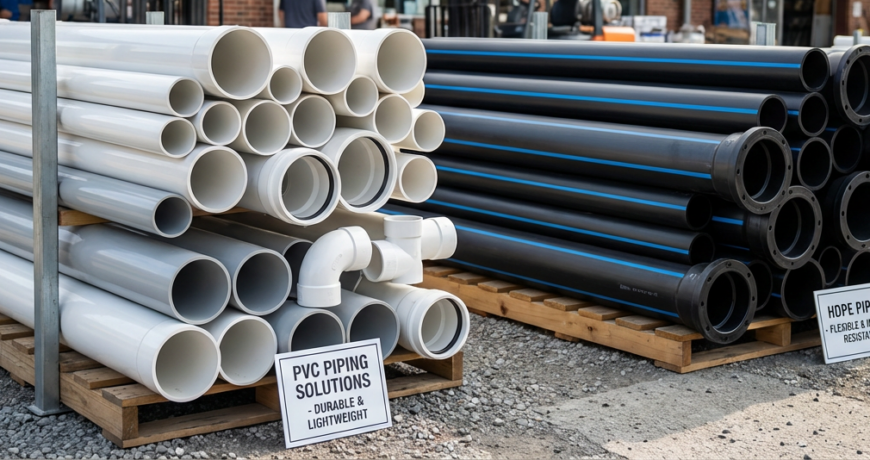
PVC (Polyvinyl Chloride) pipes have been the traditional workhorse of Kenyan irrigation for decades. These rigid, smooth-walled pipes are available in pressure classes from Class C (light-duty) to Class E (heavy-duty). Manufacturers produce PVC pipes both locally and internationally, making them widely accessible across Kenya.
They’re typically joined using solvent cement (glue). Consequently, farmers favor them for mainlines, sub-mains, and permanent installations where straight runs dominate.
What is HDPE Pipe?
HDPE (High-Density Polyethylene) pipes represent newer technology that’s gained significant traction in commercial agriculture. These flexible pipes are delivered in coils or straight lengths. Moreover, they’re joined through heat fusion or mechanical fittings, offering different performance characteristics.
Farmers increasingly specify HDPE for challenging terrain, buried laterals, and applications where joint integrity is paramount.
Why Material Selection Matters
Both materials serve Kenyan farms effectively when properly specified and installed. However, the question isn’t which is universally “better.” Instead, it’s which lasts longer under your specific soil conditions, water chemistry, installation methods, and operational stresses.
That’s where Namani Irrigation’s consultative approach makes the difference. We match the pipe to the application, not the application to whatever pipe is cheapest this season.
The Decisive Factors: Head-to-Head Durability Analysis for Kenyan Conditions
1. Chemical & Corrosion Resistance: Performance Against Fertilizers and Soil Chemistry
Kenyan soils present diverse chemical challenges. For instance, the Central Highlands feature acidic volcanic soils. In contrast, parts of the Rift Valley show alkaline conditions. Additionally, coastal and arid regions often have saline groundwater. Each environment tests pipe materials differently.
HDPE’s Chemical Performance
HDPE pipes demonstrate superior chemical resistance across nearly all agricultural chemicals. Polyethylene is inherently inert to fertilizers, including aggressive formulations like ammonium nitrate and potassium chloride. Furthermore, HDPE resists herbicides, pesticides, and the organic acids naturally present in fertile soils.
HDPE does not corrode, pit, or degrade when exposed to saline irrigation water. This makes it ideal for farms using borehole water with elevated sodium or chloride levels. Consequently, HDPE maintains its structural integrity and pressure rating throughout its service life, even when fertigating heavily.
PVC’s Chemical Performance
PVC pipes also offer good chemical resistance to most agricultural inputs. They perform well in neutral to slightly alkaline soils. However, certain organic solvents can affect PVC. It also exhibits slightly reduced resistance to highly saline conditions over extended periods.
The solvent-cement joints, while strong when properly cured, create a slightly weaker chemical bond zone compared to the parent pipe material. Nevertheless, for the vast majority of Kenyan irrigation applications using standard NPK fertilizers and municipal or borehole water, PVC’s chemical resistance is entirely adequate.
Verdict: HDPE edges ahead in extreme chemical environments and saline water conditions. For conventional fertigation with moderate water quality, both materials perform reliably for decades.
2. Impact & Crack Resistance: Surviving Physical Stress and Installation Damage
Installation quality determines longevity. Additionally, pipe material determines how forgiving that installation can be. Kenyan installation conditions demand impact resilience—rocky volcanic soils in Nyeri, manual backfilling labor, and equipment traffic crossing buried lines all pose challenges.
HDPE’s Impact Durability
HDPE pipes are remarkably tough. Their molecular structure allows significant deformation before cracking. As a result, HDPE absorbs impacts that would shatter rigid pipes. This flexibility means HDPE can endure rough handling during transport, accidental strikes with hoes or excavators, and the stress of stones settling against the pipe wall after backfilling.
HDPE’s performance in cold conditions is particularly notable. While Kenya’s lowlands don’t freeze, high-altitude farms in areas like Timau or the slopes of Mount Kenya can experience near-freezing temperatures. HDPE remains flexible and crack-resistant even at low temperatures. Meanwhile, rigid materials become brittle.
PVC’s Impact Vulnerabilities
PVC pipes, being rigid thermosets, are more vulnerable to impact damage. A sharp blow from a rock during backfilling can initiate cracks. Similarly, stress from poor bedding or point loading from equipment traffic causes problems. These cracks may not manifest immediately but propagate under pressure cycles.
PVC becomes noticeably more brittle at higher elevations where nighttime temperatures drop. The material’s rigidity, while beneficial for maintaining alignment in straight installations, works against it when physical abuse occurs. Proper installation—careful trenching, sand bedding, and controlled backfilling—mitigates these risks. However, human error happens on every farm.
Verdict: HDPE’s impact resistance significantly reduces installation-related failures. PVC requires more careful handling and installation technique but performs well when these standards are met. For farms where installation supervision may be inconsistent, HDPE offers insurance against costly mistakes.
3. UV & Heat Resistance: Enduring Kenya’s Equatorial Sunlight
Kenya straddles the equator, receiving intense UV radiation year-round. Therefore, any exposed piping faces this relentless assault. This includes surface laterals, temporary installations, and above-ground distribution lines.
HDPE’s UV Superiority
HDPE pipes manufactured with carbon black UV stabilizers demonstrate excellent resistance to photodegradation. Quality HDPE formulations maintain their structural properties for decades of surface exposure. They don’t become brittle or crack.
This makes HDPE the preferred choice for above-ground installations, drip laterals laid on mulch or plastic, and any application where burial isn’t practical. The material’s heat tolerance also allows it to handle the temperature cycling of surface installations. In these conditions, daytime pipe temperatures can exceed 50°C.
PVC’s UV Weakness
PVC pipes, despite their generally excellent properties, struggle with prolonged UV exposure. Unprotected PVC degrades under direct sunlight. It becomes chalky, brittle, and prone to cracking—often within just 2-3 years of continuous exposure.
While UV-stabilized PVC formulations exist, they’re not universally available in the Kenyan market. Even stabilized PVC doesn’t match HDPE’s UV durability. For buried applications, this limitation is irrelevant since soil provides complete UV protection. But for surface or partially exposed runs, PVC requires painting, wrapping, or other protection measures.
Verdict: HDPE wins decisively for any exposed installation. For buried systems, both materials are equally protected and this factor becomes irrelevant. The key is matching the material to the installation method.
4. Joint Integrity & Leak Resistance: The Critical Longevity Factor
Here’s the uncomfortable truth most pipe suppliers won’t emphasize: pipe failures rarely occur in the pipe itself; they occur at the joints.
Joint technology is where PVC and HDPE differ most fundamentally. Arguably, it’s the most important factor in long-term system durability.
HDPE’s Superior Fusion Joints
HDPE pipes joined through butt fusion or electrofusion create joints that are as strong as—or stronger than—the pipe itself. Heat fusion literally melts the pipe ends together. This creates a homogeneous molecular bond with no adhesives, no curing time dependencies, and no joint as a weak point.
Properly fused HDPE joints don’t leak, don’t fail under pressure cycling, and don’t separate over time. This is why HDPE is specified for critical applications like municipal water supply and mining slurry transport. For irrigation, it means your system maintains 100% pressure integrity for its entire service life.
Mechanical fittings (compression or threaded) are also available for HDPE. They provide reliable connections when fusion isn’t practical for small-diameter laterals.
PVC’s Solvent-Cement Variables
PVC pipes rely on solvent cement jointing. When done correctly, solvent-welded PVC joints are strong and durable. The process requires proper pipe cleaning, adequate primer application, correct cement application, proper insertion, and adequate curing time.
Millions of meters of PVC irrigation pipe across Kenya prove this daily. However, the process has more variables where human error creeps in. Insufficient cement, contaminated surfaces, inadequate curing before pressurization, or using degraded cement can all lead to weak joints. These joints may fail months or years later.
Additionally, solvent-cement joints create a chemically altered zone that may have different long-term properties than the base material. In practice, properly trained installers achieve excellent results. Nevertheless, the method is less foolproof than fusion.
Verdict: HDPE’s fusion jointing provides superior long-term joint integrity with less dependency on installer skill. PVC’s solvent welding delivers reliable performance when properly executed but has a wider margin for installation error. For commercial farms where professional installation is standard, both work well. For smallholder installations where training may be minimal, HDPE’s forgiveness is valuable.
5. Flexibility & Soil Movement: Performance in Expansive and Shifting Soils
Kenya’s geology presents significant challenges in certain regions. For example, the expansive black cotton soils of Naivasha and parts of the Rift Valley swell when wet and shrink when dry. This creates continuous ground movement.
Similarly, volcanic soils can be unstable. Erosion-prone slopes shift during heavy rains. How does your buried pipe network respond to these conditions?
HDPE’s Flexible Advantage
HDPE pipes exhibit exceptional flexibility. They accommodate ground movement, settling, and minor seismic activity without joint failure or cracking. This flexibility allows HDPE to follow terrain contours and navigate around obstacles with gentle bends. As a result, you need fewer fittings.
HDPE also absorbs differential settlement without developing stress cracks. In expansive soils that cyclically move, HDPE’s ability to flex without failing makes it significantly more durable than rigid alternatives. For installations crossing valleys, following contour lines, or navigating irregular terrain, HDPE installs more easily. Moreover, it maintains integrity better over time.
PVC’s Rigidity Challenges
PVC pipes, being rigid, must be installed with more numerous fittings—elbows and bends—to change direction. Each fitting represents a potential failure point. In stable soils with proper bedding and backfill, PVC’s rigidity maintains excellent alignment and grade.
However, in expansive or shifting soils, rigid pipe networks face problems. They can experience joint separation, stress cracking at direction changes, or even shearing at points where differential movement occurs. The solution is better installation technique—expansion loops, proper joint types, flexible couplings. Unfortunately, these add cost and complexity.
Verdict: HDPE’s flexibility provides superior durability in challenging soil conditions and irregular terrain. PVC performs excellently in stable soils with proper engineering but requires more careful design and installation in problematic ground.
The Verdict: Which Irrigation Pipe Lasts Longer in Kenyan Soil?
After examining the decisive durability factors, here’s the professional assessment:
HDPE pipes generally offer superior longevity in Kenyan conditions. This is particularly true in chemically aggressive environments, expansive soils, and installations requiring flexibility. Additionally, HDPE excels in any application involving above-ground exposure. The fusion-jointed system eliminates the weakest link in most irrigation networks. Furthermore, HDPE’s impact resistance reduces installation-related failures that shorten system life.
When PVC Still Makes Sense
However—and this is critical—properly specified and professionally installed PVC systems deliver excellent longevity (20-30+ years) in the right applications.
For straight-run mainlines in stable soils, buried sub-mains, and permanent infrastructure where rigidity is beneficial, PVC remains an economically sound choice. This is especially true where UV exposure is non-existent. The key phrase is “properly specified and professionally installed.”
The Three Critical Factors
The honest answer is that longevity depends on three factors:
- Material selection matched to your specific conditions (water chemistry, soil type, installation method, climate zone)
- Pipe quality (pressure class, wall thickness, manufacturing standards)
- Installation quality (jointing technique, trenching, bedding, backfilling, pressure testing)
This is why the choice shouldn’t be made from a price list or a blog article alone. It requires site evaluation and professional judgment.
The Namani Irrigation Advantage: Engineering Longevity Into Every Installation
At Namani Irrigation, we approach every project with a simple philosophy: the cheapest pipe is the one you never have to replace.
Our role extends far beyond supplying materials. Instead, we engineer durability into your irrigation system through comprehensive services.
Site-Specific Material Selection
We assess your soil type, water source chemistry, topography, crop requirements, and operational practices. Based on this assessment, we recommend the pipe material and specifications that will deliver maximum longevity.
For instance, a drip system for roses in Naivasha’s black cotton soil receives different specifications than a sprinkler system for maize in Kitale’s red loam.
Professional Installation Standards
Our installation teams are trained in proper jointing techniques for both PVC and HDPE. For PVC, this includes surface preparation, cement application, and curing protocols. For HDPE, we follow fusion procedures, cooling times, and quality inspection protocols.
We implement proper trenching depth, bedding materials, and careful backfilling. Additionally, we conduct thorough pressure testing before handover. These practices eliminate 90% of premature failures.
Quality Assurance
We supply pipes from manufacturers meeting Kenya Bureau of Standards (KEBS) specifications and international standards (ISO, DIN, ASTM). We don’t compromise on wall thickness, pressure ratings, or material grades to hit a price point.
Your system’s 20-year performance starts with quality materials, not just low initial cost.
Complete System Integration
Pipes are one component of a functioning irrigation system. We design and install the entire infrastructure—pumps, filters, valves, control systems, and distribution networks—as an integrated whole.
This systems approach prevents the common failure mode where quality pipes are undermined by improper pump sizing, inadequate filtration, or pressure surges from poor valve control.
After-Sales Support
Irrigation systems require maintenance and occasional repairs. Our service network across Kenya’s agricultural regions ensures you have support when needed. We provide genuine parts and trained technicians who understand what they installed.
Ready to stop worrying about whether your irrigation pipes will last and start knowing they will? Contact Namani Irrigation at 0797 316 959 for a professional consultation. We’ll assess your farm, recommend the optimal pipe specification, and provide a detailed quote for a complete, professionally installed system engineered for decades of reliable service.
Your Next Step to a Durable, Long-Lasting Irrigation System
Choosing between PVC and HDPE pipes isn’t about following general rules. Instead, it’s about applying specific knowledge to your unique situation.
The difference between a system that serves your farm reliably for 25 years and one that becomes a maintenance headache in 8 years often comes down to early specification decisions and installation quality.
Don’t Leave Infrastructure to Chance
Don’t leave your farm’s most critical infrastructure to guesswork or lowest-bid procurement. Instead, partner with irrigation specialists who treat your installation as if it were their own investment.
Take action today:
- Call/WhatsApp 0797 316 959 to speak directly with Namani Irrigation’s technical team about your specific irrigation needs
- Visit https://namaniirrigation.co.ke to explore our complete range of PVC and HDPE pipes, fittings, and irrigation systems
- Request a site visit for a professional assessment and customized recommendation
- Ask about our installation services to ensure your chosen pipe system is installed to last
- Follow us on social media for irrigation tips, project showcases, and special offers:
- Instagram: @namaniirrigation
- Facebook: Namani Irrigation
- TikTok: @namaniirrigation
Whether your analysis leads you to PVC, HDPE, or a hybrid system combining both materials in different zones, Namani Irrigation ensures you get the right pipe, properly installed, backed by Kenya’s most experienced irrigation specialists.
Your farm deserves infrastructure that lasts. Your crops depend on reliable water delivery. Your investment should be protected by expert guidance. Contact Namani Irrigation today—because in irrigation, longevity isn’t luck, it’s engineering.
About Namani Irrigation
Namani Irrigation is Kenya’s trusted partner for complete irrigation solutions, serving commercial farms, smallholder cooperatives, and horticultural operations across the country. With extensive experience in drip, sprinkler, and center pivot systems, we provide comprehensive services from initial consultation and system design through professional installation and ongoing maintenance. Our commitment to quality materials, proper installation standards, and customer education ensures that every system we install delivers decades of reliable performance.
Connect with us:
- Phone: 0797 316 959
- Location: Utawala – Nairobi
- Website: https://namaniirrigation.co.ke
- Instagram: @namaniirrigation
- Facebook: Namani Irrigation
- TikTok: @namaniirrigation
There are no comments