Greenhouse Installation in Kenya
Greenhouse Installation in Kenya
Greenhouse installation in Kenya has become a cornerstone of modern, profitable agriculture. It’s a simple and procedural process that allows farmers to create an optimum growing environment, ensuring consistent crop production and protection from unpredictable weather . Whether you are a smallholder or a large-scale commercial farmer, understanding the process is your first step to success.location Utawala Call or Whatsapp 0797316959.
1. Why Invest in a Greenhouse?
Kenya’s agricultural sector is increasingly turning to greenhouse farming to solve key challenges. The benefits are significant:
-
Year-Round Production: Grow crops regardless of rainfall or season, ensuring a constant supply and income stream .
-
Higher Yields and Quality: Controlled environments lead to higher yields, with some farmers seeing a return on investment within just two growing seasons. Crops like tomatoes, capsicums, and strawberries fetch premium prices .
-
Better Pest and Disease Control: Insect netting and enclosed structures significantly reduce crop losses from pests and diseases .
-
Water Efficiency: When paired with a drip irrigation system, a greenhouse minimizes water waste, a critical advantage for farms in semi-arid regions .
2. Key Considerations Before Installation
Before you start building, a thorough planning stage is essential to ensure the project is viable and profitable . Here are the critical factors to evaluate:
Site Selection
The location of your greenhouse is paramount. You need a site with:
-
Good Drainage: Waterlogging can be detrimental to crops and structures.
-
Maximum Sunlight Exposure: Avoid areas with excessive shade from trees or buildings.
-
Wind Protection: Strong winds can damage the structure and increase heat loss. If necessary, plan for windbreaks .
-
Level Topography: A level site reduces preparation costs. Avoid slopes that require extensive and expensive levelling .
Water Access
A reliable source of quality water is non-negotiable. Greenhouse farming requires frequent irrigation, so a consistent source—be it a borehole, river, or harvested rainwater—is critical .
Budgeting
Realistically factor in all costs: the structure, delivery, installation labor, site preparation, irrigation systems, and seedlings. A transparent costing is key to avoiding financial strain .
Orientation
The orientation of your greenhouse is crucial for optimizing light capture. The general rule is an east-west orientation. This means the longer side of the structure faces east and west, while the shorter sides face south and north. This allows the sun’s rays to enter from the sides without being blocked by the frame’s ribs .
3. Types of Greenhouses in Kenya
Choosing the right structure is a balance of budget, durability, and purpose. Here’s a breakdown of the most common types available :
4. Step-by-Step Installation Process
The process of installing a greenhouse involves a series of well-defined stages. Here is a typical procedure followed by professional installers in Kenya :
a) Site Visit and Planning
The process begins with a professional visit to your farm to assess the land for suitability and take measurements. This is where your goals, budget, and crop choice are discussed to finalize the design .
b) Site Preparation
-
Level the Ground: The land is cleared and leveled. If the ground is uneven, holes are dug to an appropriate depth (approx. 2 feet) for the anchor posts .
-
Prepare Anchors: Anchor posts (wooden or metallic) are set into the prepared holes and secured with a cement and sand mixture for stability .
c) Assemble the Structure
-
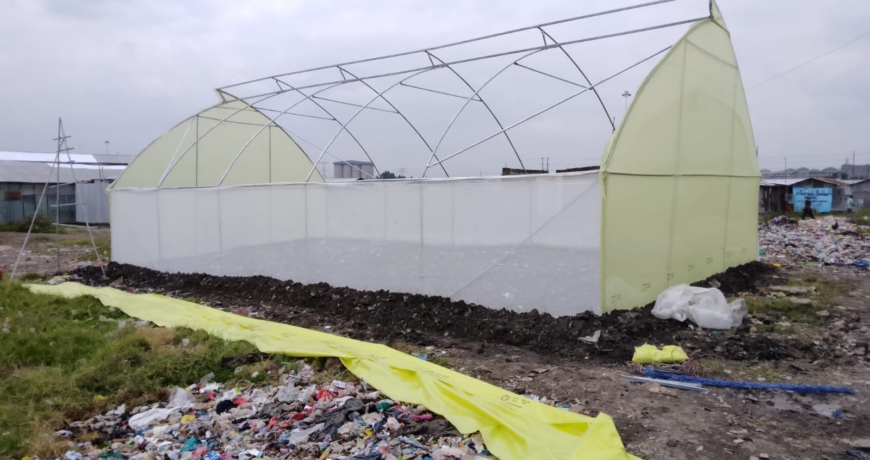
Build the Frame: The main structural frame is assembled. For wooden greenhouses, treated poles are joined using nails. For metallic greenhouses, steel pipes are fabricated and connected using tapping screws to form arches for the roofing .
-
Install Ventilation: Ventilation systems are installed to regulate temperature and humidity. This could be in the form of top vents or roll-up side netting .
d) Covering and Sealing
-
Lay the Polythene Cover: A UV-treated polythene cover (ideally 200 microns thick) is stretched over the roof. It is secured along the edges using a system of profile channels and wiggle wires . The cover is cut into pieces to match the sections of the greenhouse .
-
Attach Insect Nets: Insect nets are fixed on the side walls and ventilation points to keep pests out. They are attached using nails for wooden structures and wires for metallic ones .
e) Install Irrigation
A drip irrigation system is installed. This kit includes drip lines, water filters, and connections to a water tank. The system is tested to ensure it delivers water efficiently and uniformly to the crops .
5. Greenhouse Installation Costs in Kenya (2025/2026)
The total cost depends on the size, type of frame, and location. Below are indicative price ranges for standard greenhouses.
Note: Prices often include the structure and installation, but always confirm with your supplier.
6. Why Choose a Professional Installer
-
Access to Premium Materials: They use high-quality, UV-stabilized polythene and galvanized steel pipes that resist rust and last for years .
-
Expertise and Speed: Professional teams have years of experience, ensuring fast and correct setup. In some cases, delivery and installation can happen within days .
-
After-Sales Support: Reliable dealers offer training, technical advice, and support even after the installation is complete .
-
Turnkey Solutions: Many companies manage the entire process—from design and delivery to installation and training—taking the stress out of the project .
There are no comments