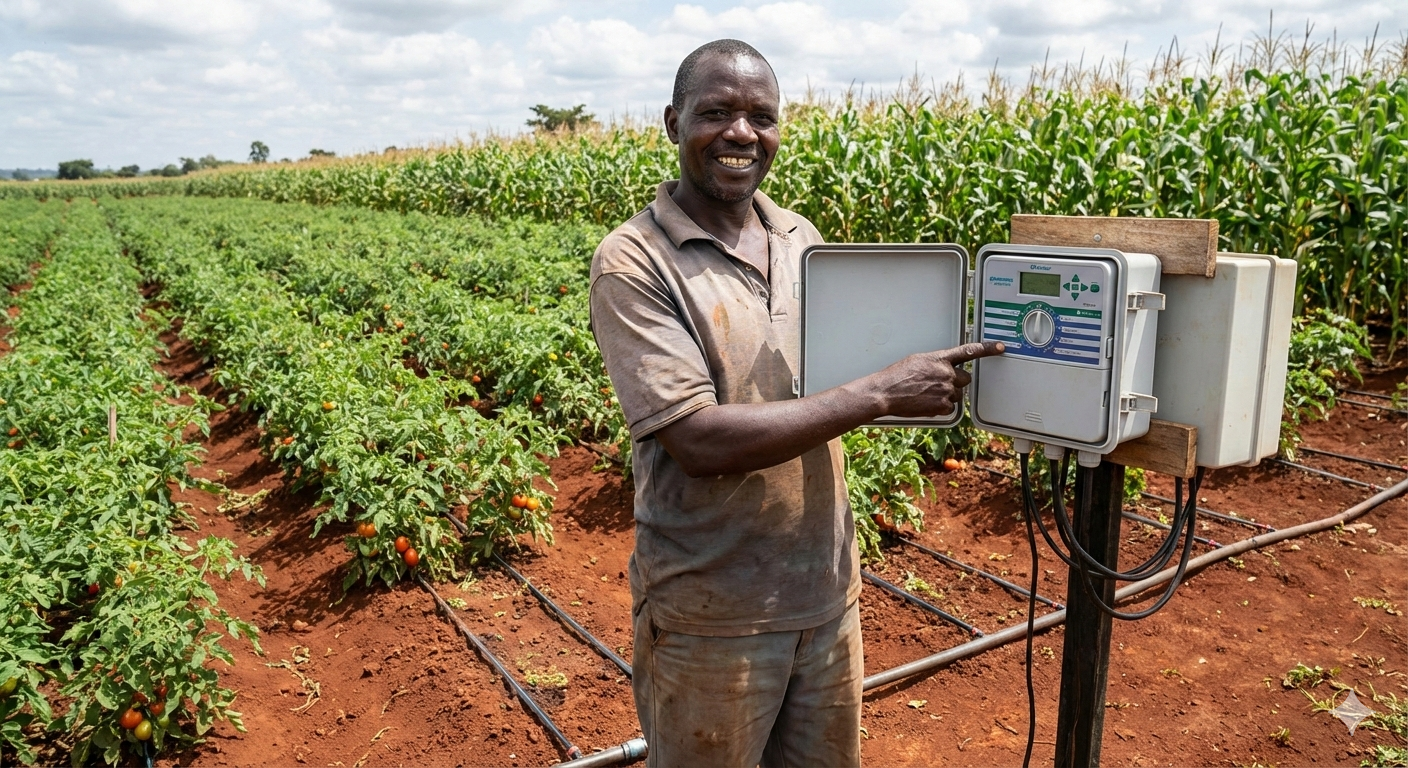
Raingun Irrigation Systems in Kenya
Raingun Irrigation Systems in Kenya
For the commercial farmer in Kenya, time is literally money. Waiting for rains or relying on manual watering methods limits your potential to one or two seasons per year. This is where raingun irrigation systems change the game. Often referred to as “rainmakers,” these high-volume sprinklers are designed to cover large areas quickly, making them the preferred choice for expansive maize fields, wheat plantations, and even coffee estates .
At Namani Irrigation, we don’t just sell equipment; we engineer solutions. Based in Utawala and serving farmers across Kiambu, Nakuru, Machakos, and beyond, we understand that a successful raingun system requires more than just water pressure—it requires precision design and consistent upkeep .
Ready to irrigate 5 acres in a fraction of the time? Call us at 0797316959 to schedule a farm survey.
Why Choose a Raingun for Large-Scale Farming?
Before we dive into costs and maintenance, it is vital to understand why a raingun might be the right fit for your specific operation. Unlike drip lines that water individual plants slowly, rainguns are about volume and coverage .
-
Rapid Coverage: A single heavy-duty raingun can cover up to 3 acres in one position, making it ideal for large, open fields.
-
Labor Efficiency: Instead of moving hoses every hour, your team moves the raingun just a few times a day.
-
Versatility: Rain guns work exceptionally well for tall crops like maize, sunflowers, and sugarcane where overhead irrigation is necessary.
-
Frost Protection & Cooling: In high-altitude areas, rainguns are used to protect crops from frost damage and cool the microclimate during extreme heat.
However, they are not a “set and forget” technology. They require higher pressure than drip systems, which means your pump selection is critical to success .
2026 Price Guide: What Affects Your Raingun System Cost?
The raingun irrigation system cost in Kenya is often misunderstood because farmers look at the price of the gun alone. At Namani Irrigation, we emphasize the total system cost to ensure you don’t experience pressure failures in the middle of a dry spell.
1. The Raingun Unit (KES 8,000 – KES 90,000)
The price varies based on nozzle size, construction material (plastic vs. brass), and brand.
-
Entry-Level Plastic Guns (1″ – 1.5″): KES 8,000 – 12,000. Suitable for small pastures or nurseries.
-
Commercial Metallic Guns (2″): KES 17,000 – 50,000. Standard for 1-2 acre plots.
-
Heavy-Duty Sector Guns (2.5″): KES 20,000 – 90,000. Designed for full-circle coverage on large estates.
2. The Pumping System (KES 30,000 – KES 150,000)
This is the heart of your operation. Rain guns typically require 4 to 6 bars of pressure.
-
Diesel Pumps: Preferred for remote locations without grid power. Prices depend on horsepower (HP).
-
Electric/Solar Pumps: Lower operating costs over time. Namani Irrigation specializes in integrating solar-powered solutions to eliminate fuel costs, a strategy that has helped farmers in Machakos reduce their energy bills by 70% .
3. Piping & Accessories (KES 80,000 – KES 150,000 for 5 acres)
We recommend HDPE pipes over standard PVC because they handle pressure surges better and last longer under the Kenyan sun. You will also need quality hose clamps, stands, and sometimes a 2″ irrigation filter to prevent nozzle blockages .
4. Installation & Design (KES 15,000 – KES 40,000)
Professional design prevents “dry spots.” Our team at Namani Irrigation conducts a topographic survey to ensure every corner of your field receives adequate water .
Total Estimated Investment: For a standard 5-acre maize farm, a complete, professionally installed raingun system ranges from KES 180,000 to KES 350,000. While this seems significant, farmers typically recover this investment within two seasons through labor savings and increased yields .
Maintenance Guide: Keeping Your Rainmaker Alive
A raingun is a mechanical device exposed to dust, debris, and high pressure. Neglecting maintenance is the fastest way to turn a valuable asset into a rusted paperweight. Based on our service records at Namani Irrigation, here is your essential maintenance checklist.
1. Monthly Checks: The “Listen and Look” Approach
-
Visual Inspection: Walk your line while the system is running. Look for geysers (leaks) in the pipes and check that the raingun is rotating smoothly. If it stops rotating, water pools in one spot, destroying crops.
-
Nozzle Check: Remove the nozzle and check for debris. Sand or small stones can get past filters and slowly erode the brass, widening the nozzle and ruining your water distribution pattern.
-
Lubrication: Apply grease to the drive mechanism and bearings. Dust in Kenya is abrasive; lubrication is your first line of defense.
2. Seasonal Maintenance: Between Harvests
-
Flush the System: Remove the end caps on your mainlines and laterals. Turn on the water briefly to flush out any sediment that has accumulated.
-
Inspect Rubber Seals: O-rings and gaskets dry out and crack. Replacing a KES 200 seal is much cheaper than replacing a KES 20,000 gearbox.
-
Check the Pump: Change the oil in your diesel pump and clean the air filters. A straining pump cannot deliver the pressure your raingun needs.
3. The Silent Killer: Water Quality
Poor water quality is the number one cause of raingun failure we see at Namani Irrigation. Muddy water from rivers or open dams acts like sandpaper on the internal components.
-
The Solution: Invest in a proper filtration system. A simple screen filter can extend the life of your raingun by years .
Case Study: Turning a Loss into a Legacy
To give you a real-world perspective, consider the story of David, a farmer in Kiambu who transitioned from manual watering to smart irrigation with Namani.
After being laid off from his corporate job, David turned to his grandfather’s one-acre plot. Initially, he struggled with water waste and inconsistent yields. He was spending three hours daily watering and losing 50% of his water to evaporation.
After consulting with us, he didn’t just buy a raingun; he installed a complete system. Within six months, his tomato harvest tripled from 8kg per plant to 22kg per plant. His water consumption dropped by 70% because the targeted application (combined with mulching) meant no water was wasted .
“I was using approximately 15,000 liters of water weekly for substandard production. After Namani, my water consumption dropped to just 4,500 liters—a 70% reduction.” – David, Kiambu Farmer .
He has since expanded from 1 acre to 5 acres and now employs workers from his community. This is the power of choosing the best irrigation companies in Kenya—you get a partner, not just a supplier .
Raingun vs. Drip: Making the Right Choice
Many farmers ask us: “Should I get a raingun or drip lines?” The answer depends on your crop.
| Feature | Raingun Irrigation | Drip Irrigation |
|---|---|---|
| Best For | Maize, Wheat, Sugarcane, Pasture | Tomatoes, Kale, Onions, Fruits |
| Water Pressure | High (4-6 Bar required) | Low (1-2 Bar sufficient) |
| Water Efficiency | Good (70-80%) | Excellent (90-95%) |
| Labor | Low (move gun 2x daily) | Very Low (automated) |
| Foliage Wetting | Yes (can increase disease risk if timed poorly) | No (dry leaves, less disease) |
The Verdict: If you are growing tall, dense crops over a large area, the raingun is your tool. If you are growing high-value row crops like vegetables or herbs, drip irrigation combined with mulching is the ultimate “power couple” for water savings .
Ready to Harness the Power of Rain?
At Namani Irrigation, we are committed to transforming Kenyan agriculture through smart technology. Whether you are looking to install a new raingun system or optimize an existing one, our team is ready to help.
We provide end-to-end service:
-
Site Assessment: We analyze your soil, water source, and topography .
-
Custom Design: We size your pipes and pump correctly to avoid pressure loss .
-
Professional Installation: We ensure every joint is watertight.
-
Farmer Training: We teach you and your staff how to maintain the system for decades of service .
Contact Namani Irrigation Today:
Call or WhatsApp: 0797316959
Visit Our Showroom:
Utawala, Along Eastern Bypass
Next to Quickmart kwa Chief
Nairobi, Kenya
Website: www.namaniirrigation.co.ke
Follow us for farming tips and success stories:
-
Facebook: Namani Irrigation
-
TikTok: @NamaniIrrigation
-
Instagram: @NamaniIrrigation
There are no comments