
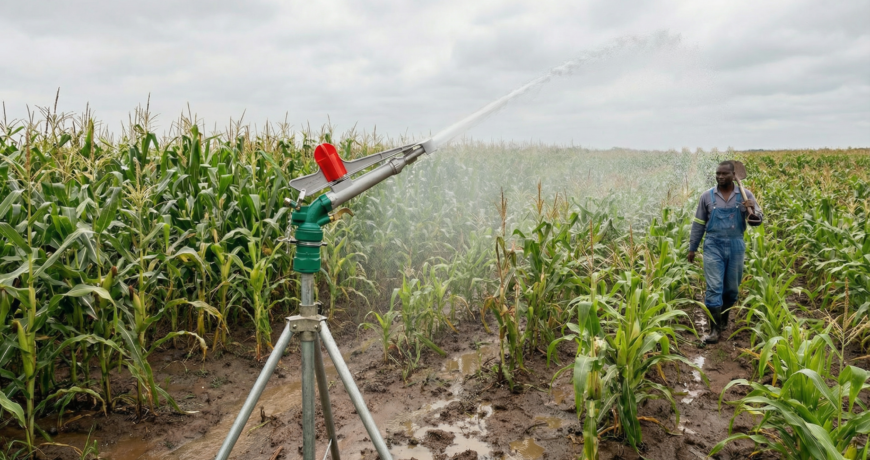
Raingun Sprinkler Price in Kenya 2026
Raingun Sprinkler Price in Kenya 2026: Complete Buyer’s Guide & Expert Recommendations
Picture this: watering 5 acres of maize in just 2 hours with the precision of natural rainfall, using 40% less water than traditional methods. For Kenyan farmers facing climate unpredictability and rising operational costs, raingun irrigation isn’t just smart farming—it’s survival strategy.
At Namani Irrigation, we’ve installed over 500 raingun systems across Kenya. We understand that you’re not just buying equipment; you’re investing in your farm’s future profitability and resilience.
Ready to transform your farm? Call us at 0797316959 for a free consultation.
Understanding Raingun Irrigation Systems: Beyond the Price Tag
When farmers search “raingun sprinkler price in Kenya,” most focus only on the gun unit. This is like buying a car engine without considering the transmission, wheels, or fuel system. A complete raingun system includes multiple critical components that work together to deliver results.
The Four Investment Components You Need to Consider
1. The Raingun Unit (Your Water Distribution Engine)
The raingun itself determines coverage area and water distribution uniformity. Key specifications include inlet size (1.5″ to 2.5″), throw radius (20m to 70m+), and build quality. A poorly sized gun will either waste water through over-application or leave dry patches that reduce yields.
According to FAO irrigation guidelines, proper sprinkler selection is critical for achieving uniform water distribution and optimal crop yields.
2. High-Pressure Pump System (Your Power Source)
Your raingun requires consistent pressure—typically 4-6 bars—to function effectively. Pump selection depends on your water source depth, distance to field, and terrain elevation. We typically recommend diesel pumps for remote locations and electric pumps where grid power is reliable. Undersized pumps are the number one cause of raingun system failure.
Learn more about agricultural water pumping systems from the Irrigation Association.
3. Piping Infrastructure (Your Delivery Network)
Quality matters dramatically here. Our HDPE irrigation pipes resist UV degradation and maintain pressure better than PVC alternatives. Pipe diameter must match your flow requirements—undersized pipes create friction loss that reduces raingun performance by up to 30%.
4. Water Source & Storage (Your Foundation)
Consistent water availability is non-negotiable. Many successful farmers combine raingun systems with professionally installed dam liners to create on-farm water reservoirs. This ensures irrigation continues even during dry spells when river levels drop.
The Kenya Ministry of Agriculture emphasizes water harvesting as a critical component of climate-smart agriculture.
Want expert guidance on system sizing? Contact our engineers for a free farm assessment.
2026 Raingun Pricing Guide: What to Expect in Kenya
Based on current market conditions and our supplier relationships, here’s what different raingun systems cost. These prices reflect gun units only—complete system costs vary based on your specific requirements.
| System Category | Specifications | Coverage Area | Price Range (KES) | Best For |
|---|---|---|---|---|
| Entry-Level Plastic | 1.0″-1.5″ inlet, 20-25m radius | 0.1-0.2 acres | 5,000 – 9,000 | Home gardens, small nurseries |
| Mid-Range Metallic | 1.5″-2.0″ inlet, 30-45m radius | 0.5-1 acre | 14,000 – 25,000 | Small-scale commercial farms |
| Professional Heavy-Duty | 2.0″-2.5″ inlet, 50-70m radius | 1.5-3 acres | 40,000 – 90,000 | Large commercial operations |
| Complete 1-Acre Turnkey | Includes pump, pipes, gun, installation | Full coverage | 90,000 – 200,000 | Farmers wanting plug-and-play solutions |
Why Such Price Variation?
Three factors drive the cost differences: build materials (plastic versus brass/bronze alloys), internal mechanisms (impact drive versus precision gear systems), and engineering complexity. Heavy-duty units feature reinforced bearings, adjustable flow rates, and corrosion-resistant coatings that justify their premium pricing through longevity—often outlasting cheap alternatives by 10+ years.
For technical specifications on sprinkler irrigation efficiency, refer to irrigation engineering resources from the USGS.
Important note: The raingun typically represents just 20-30% of your total system investment. Attempting to “save money” by buying an undersized gun or cheap pump usually results in poor performance and higher long-term costs.
Need a detailed quote? WhatsApp us at 0797316959 with your farm size and location.
Real-World Application: Calculating Your Potential Returns
Consider a typical 5-acre maize farm in Kiambu. Traditional irrigation requires 4 workers spending 6 hours daily moving pipes and managing water flow. That’s 24 labor hours per day at approximately KES 500/day per worker—KES 2,000 daily or KES 60,000 monthly.
A properly designed raingun system reduces this to 1 worker spending 2 hours daily positioning the gun and monitoring operation. Your new labor cost: KES 500 daily or KES 15,000 monthly. That’s a monthly saving of KES 45,000.
Even with a KES 180,000 complete system installation, your payback period is under 4 months through labor savings alone. This calculation doesn’t include yield increases from improved water distribution uniformity or water cost reductions—which can add another 20-30% to your ROI.
Research from the International Water Management Institute shows that efficient irrigation systems can increase crop yields by 20-40% while reducing water consumption.
Ready to calculate your farm’s ROI? Call 0797316959 to speak with our irrigation consultants.
Why Namani Irrigation? What Sets Us Apart
We’ve been in business long enough to see countless farmers make expensive mistakes with irrigation. Here’s how we ensure your investment delivers returns:
Precision System Design: We don’t guess. Our engineers conduct topographic surveys, calculate actual pressure requirements, and design systems with proper pipe sizing and pump capacity. This prevents the performance issues that plague DIY installations.
Quality Component Sourcing: We stock only field-proven brands that survive Kenyan conditions. This includes our specialized irrigation filters that prevent the nozzle clogging that destroys water distribution uniformity.
Professional Installation & Training: Your workers receive hands-on training in system operation, maintenance schedules, and troubleshooting. We don’t just drop off equipment—we ensure your team can maximize its potential.
Ongoing Technical Support: Irrigation problems don’t respect business hours. When you have issues during critical growing periods, you can reach our support team promptly.
ROI-Focused Solutions: We calculate payback periods based on your specific crops, water costs, and labor savings. Our goal is designing systems that demonstrably increase your profitability.
For more insights on modern irrigation practices in Kenya, visit the Agricultural Society of Kenya website.
Questions about system design? Email us at sales@namaniirrigation.co.ke for technical guidance.
Making the Right Choice: Your Next Steps
Irrigation is too important to leave to chance. Poor system design wastes your initial investment and costs you opportunity losses through reduced yields and inefficient operations.
Frequently Asked Questions
How much water does a raingun use per hour? Flow rates vary by gun size, typically ranging from 20-80 cubic meters per hour. We calculate optimal flow rates during system design to match your water availability and crop requirements.
Can I use a raingun with my existing borehole? Possibly, but this requires professional assessment. We need to verify your borehole yield, static water level, and pump capacity before confirming compatibility.
What ongoing maintenance do raingun systems require? Monthly: clean filters and inspect nozzles. Quarterly: lubricate moving parts and check pipe connections. Annual: professional service inspection. We provide detailed maintenance schedules with all installations.
Do you offer financing or payment plans? Please contact our sales team directly to discuss available payment arrangements for qualified customers.
What warranty comes with your systems? Warranty terms vary by component manufacturer, typically ranging from 12-24 months. We provide specific warranty documentation with all quotations.
Ready to Transform Your Farm’s Productivity?
Get your FREE professional farm assessment and accurate quote today.
Don’t guess about costs or system requirements. Our irrigation engineers will visit your farm, evaluate your water source, measure your land, and provide a detailed proposal with ROI projections.
Contact Namani Irrigation Today:
Call or WhatsApp: 0797316959 (Fast Response – Available 7 Days a Week)
Email Us: sales@namaniirrigation.co.ke
Visit Our Showroom: Get Directions
Utawala, Along Eastern Bypass
Next to Quickmart kwa Chief
Nairobi, Kenya
Website: namaniirrigation.co.ke
Connect With Us:
Facebook | TikTok
Namani Irrigation: Delivering the Perfect Water Solution for Every Farm
Professional irrigation system design, supply, and installation across Kenya. Serving farmers in Kenya and East Africa
There are no comments


